The Crisis That Isn't Going Away
The hospitality staffing shortage in Australia has moved from pandemic disruption to structural reality. According to Jobs and Skills Australia, chefs remained on the national Skills Priority List throughout 2025, reflecting a persistent gap between the demand from venues and the supply of qualified candidates.
This isn't a temporary dip. The Australian hospitality industry faces a confluence of pressures that have fundamentally altered the labour market:
- Recruitment and retention difficulty — historically high turnover rates, with many workers leaving for sectors offering better pay or more predictable hours
- Rising wage expectations — cost-of-living increases have driven demand for higher wages, while restaurant margins remain tight
- Shrinking training pipeline — fewer apprentices entering the industry, compounded by the loss of experienced workers during the pandemic recovery
- Regional disparities — shortages are particularly acute in regional and remote tourist destinations, where attracting and housing staff presents additional logistical challenges
The practical consequences are visible across the industry. Operators report reducing trading hours, working significantly longer hours themselves, increasing reliance on casual staff with higher turnover, and rising pressure on existing employees — which has been linked to increased fatigue and stress, according to research from jobsandskills.gov.au.
The Technology Response
Rather than replacing staff — which 74% of operators say is not the goal, per the National Restaurant Association — the most successful operators are using technology to make smaller teams more effective. The same report found that 82% of restaurant executives plan to increase their investment in AI and automation in 2026.
The data supports this approach. Among operators who increased technology investment over the past two to three years, 69% reported improved operational efficiency and productivity. And 77% of restaurants using digital ordering systems report increased efficiency, with 61% reporting reduced staff work pressure, according to industry research from lavu.com.
The key areas where technology directly addresses the staffing gap:
1. Order Automation
QR-based self-ordering removes the most transactional — and most repetitive — element of front-of-house work. When guests place their own orders, staff are freed for genuine hospitality tasks: recommending dishes, managing dietary needs, ensuring satisfaction. The order that reaches the kitchen is exactly what the guest intended, eliminating the verbal relay chain that causes errors.
For a venue doing 80 covers per service, this represents 40–90 minutes of wage cost per service redirected from order-taking to value-adding work — or absorbed entirely in a leaner staffing model.
2. Kitchen Display Systems
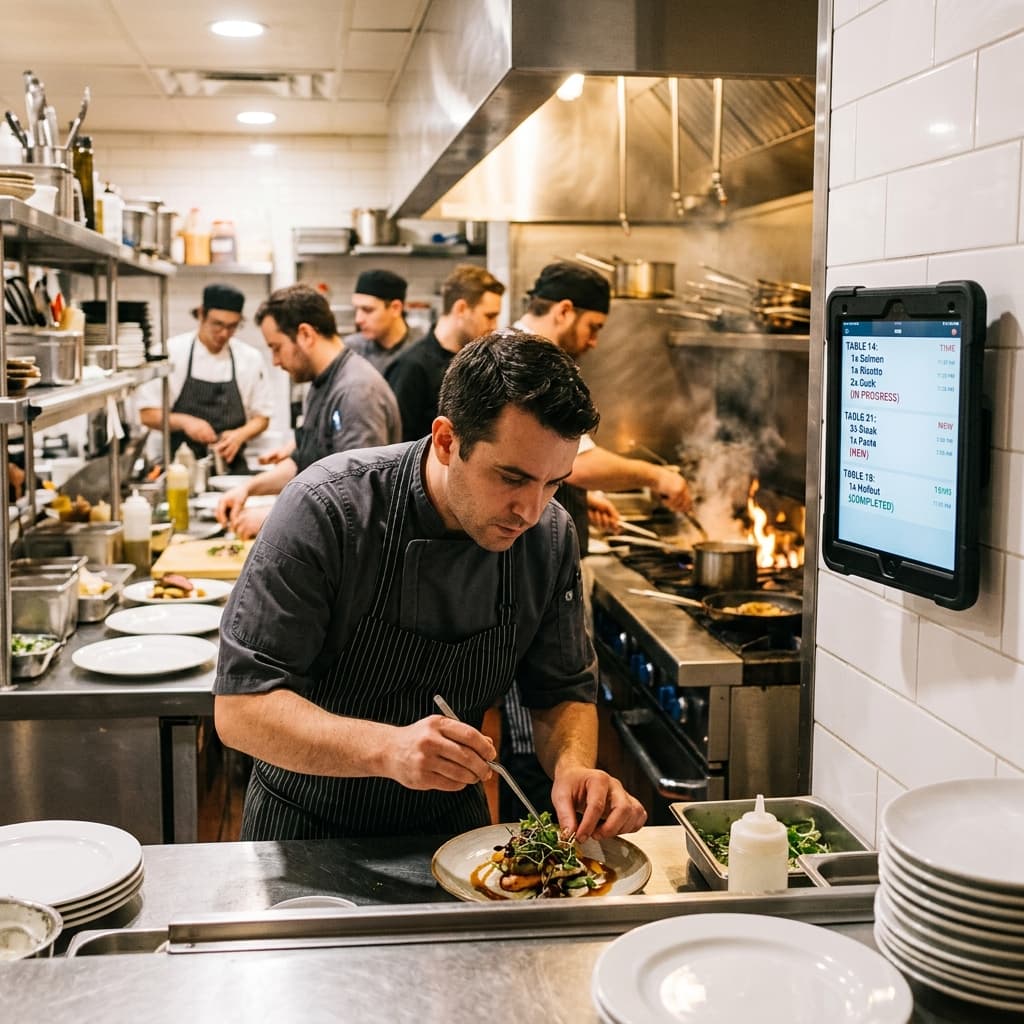
A KDS replaces paper tickets — which are prone to loss, misreading, and damage during busy periods — with a clear, prioritised digital display. Orders are automatically routed to the correct prep station, special requests and allergies are prominently displayed, and the entire kitchen operates from a single source of truth.
The impact is material: order errors reduced by up to 90%, kitchen efficiency improved by 15–25%, and customer wait times reduced by 20–30%. For a kitchen short one prep cook, the efficiency gains from a KDS can partially offset the missing hands.
3. Multilingual Self-Service
In tourist-heavy venues, serving international guests without multilingual staff is a major friction point. When guests can browse and order in their own language, the need for staff to verbally bridge language barriers disappears. This is particularly valuable for venues that would otherwise need to hire specifically for language skills — a requirement that further narrows an already tight talent pool.
International tourists spent $39.2 billion in Australia in 2025, with food and beverage among the fastest-growing spending categories. A multilingual digital menu captures this spending without requiring multilingual staff.
4. Real-Time Menu Management
When a dish is sold out, a digital menu removes it instantly across every table. No staff time spent walking the floor to inform guests. No orders placed for items the kitchen can't fulfil. No remade dishes, no comps, no awkward conversations. For a short-staffed team already under pressure, these small time savings compound across a service.
The Numbers That Matter
The efficiency metrics paint a clear picture of what technology can achieve for understaffed operations:
- Customer wait time reduction: 20–50% (lavu.com)
- Order accuracy improvement: 23–30% (octotable.com)
- Kitchen efficiency improvement: 15–25% (lavu.com)
- 77% of restaurants report increased overall efficiency (lavu.com)
- 61% of restaurants report reduced staff work pressure (lavu.com)
- Order management time reduction: 10% (fishbowl.com)
These are not transformative individually — no single metric solves a staffing shortage. But compounded across every service, every shift, every week, they represent a meaningful operational advantage for venues competing for the same shrinking pool of available staff.
What the NRA Report Gets Right
The National Restaurant Association's 2025 report offers a useful reality check. It confirms that technology is not a silver bullet — only 28% of operators report improved profitability from technology investments, and only 30% report improved employee training.
But it also confirms where technology genuinely helps: 69% report improved efficiency, and the demand from consumers — particularly younger demographics — is unambiguous. The hotels are that restaurants need to deploy technology thoughtfully, targeting the specific operational friction points where it creates genuine value, rather than automating for its own sake.
The staffing shortage is structural. It is not resolving. The operators who thrive will be those who build systems that allow smaller, better-supported teams to deliver consistently excellent guest experiences — and the data increasingly points to smart technology as the enabler that makes this possible.
Where to Start
For operators feeling the staffing pressure today, the most impactful first step is usually the simplest: a QR menu with self-ordering and a kitchen display. This combination addresses the three largest time drains — taking orders, relaying orders, and managing order errors — in a single implementation.
No new hardware beyond a tablet for the KDS. No app for guests to download. No complex integration with existing systems required. Just fewer things going wrong during service, and more time for your team to focus on the parts of hospitality that guests actually remember.