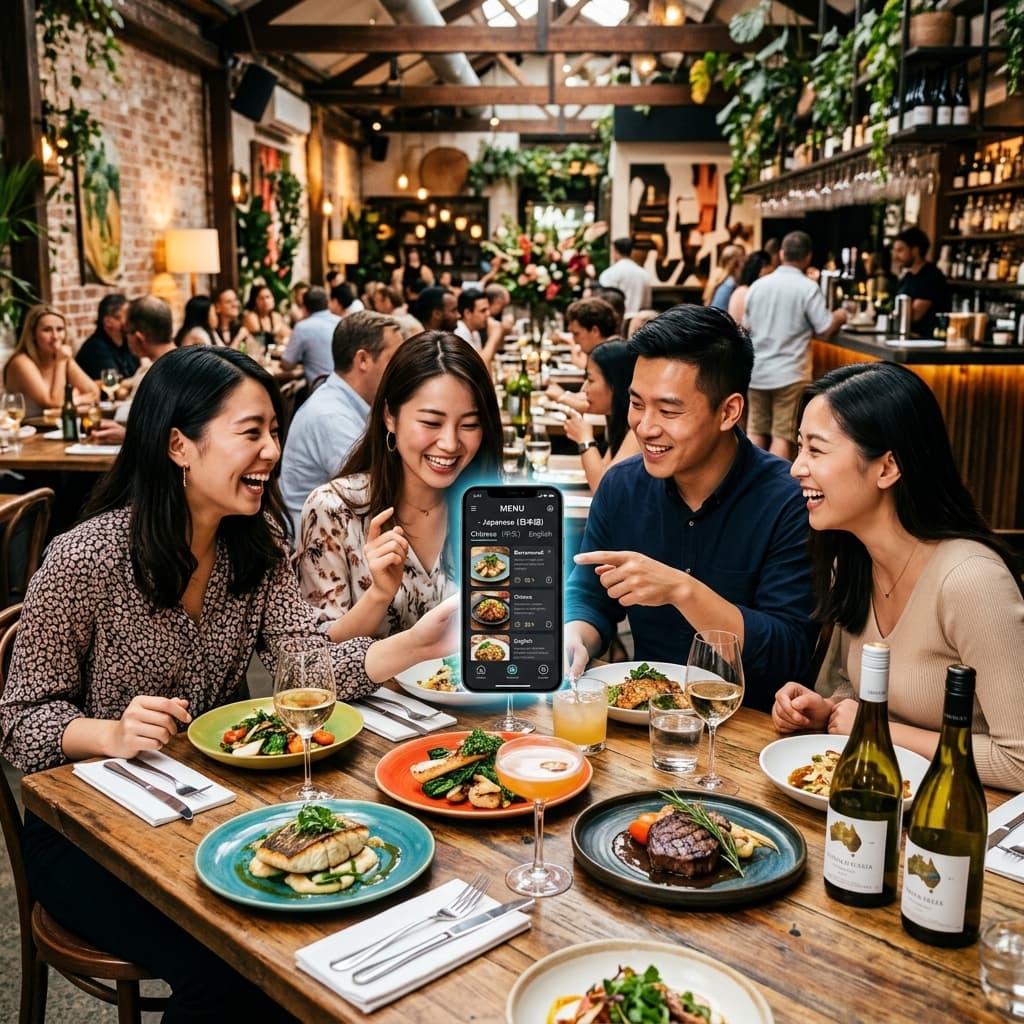
The International Guest Problem Nobody Talks About
Walk into a Nepali restaurant in Tokyo. The menu is in Japanese. You speak neither Nepali nor Japanese. The staff speak enough of both to take orders from regulars, but the conversation stalls as soon as you try to ask about the difference between two curries. You point at something. You hope for the best.
This experience is so universal that most international travellers have simply accepted it as part of eating abroad. But for the restaurant, it is a quiet revenue leak — every confused guest who orders fewer dishes, every table that skips dessert because asking felt too complicated, every tourist who walks past the door because the menu board outside was unreadable.
The gap between "serving international guests" and "optimised for international guests" is measurable in dollars — and the data on just how large that gap is has become increasingly clear.
The Numbers Behind the Opportunity
The figures are striking. According to Tourism Research Australia (TRA), international visitors spent $39.2 billion in Australia in the year ending December 2025 — a 19% increase compared to 2024. The Australian Bureau of Statistics (ABS) Tourism Satellite Account for 2024–25 recorded international tourism consumption at $42.3 billion (current prices), the highest level in the time series.
Crucially, the ABS report noted that food and beverages — including takeaway and restaurant meals — were among the products with the highest growth during this period, driven by both increased visitor numbers and rising prices.
For context, Japan welcomed 36.9 million international visitors in 2024 — a record — with food and dining accounting for a significant share of trip expenditure.
The opportunity cost is not theoretical. Research cited by tmenu.ai suggests that tourists spend 20–30% more when they fully understand the menu. It is the bill that would have been A$20 larger if the guest had confidently ordered the appetiser they were curious about.
Why Language-Ready Menus Convert Better
The mechanism is rooted in consumer psychology. Research from call-the-service.com and easymenus.net identifies four specific behavioural changes when guests can read a menu in their native language:
- Reduced anxiety and uncertainty — confidence about food choices, allergens, and ingredients eliminates stress from the ordering process
- Full menu exploration — guests move beyond "safe" or familiar items and are more likely to order appetisers, premium specialties, drinks, and desserts
- Perception of quality and inclusivity — offering multilingual options signals professionalism and a welcoming environment, driving positive reviews and repeat intent
- Reduced staff explanation time — fewer verbal explanations across language barriers means faster service and potentially higher table turnover
The underlying principle is straightforward: people spend more on things they understand. This applies to wine lists, product pages, and everything in between. For international guests who are willing to spend but unable to navigate the menu, language support directly converts hesitation into revenue.
The Four Languages That Matter Most for Australian Restaurants
For Australian restaurants, the international visitor mix points to four languages that collectively cover the vast majority of non-English speaking guests:
- Japanese — Japan is consistently Australia's top-three source market for high-spend international visitors
- Simplified Chinese — mainland Chinese visitors account for the largest international visitor spend in absolute terms
- Korean — South Korea sends a rapidly growing number of visitors, particularly to Melbourne and Sydney
- Traditional Chinese — Hong Kong and Taiwanese visitors, with distinct preferences from mainland Chinese guests
A restaurant doesn't need perfect translation across all languages on day one. Starting with the two or three most common source markets for your specific location creates the majority of the benefit. Digital menus can support numerous languages without the space constraints of print — something unitedlanguagegroup.com emphasises as a fundamental advantage over physical menu translation.
Beyond Translation: The Role of Visuals
Even a perfectly translated menu has limits. For guests from cultures where a dish is genuinely unfamiliar — a South Korean tourist reading a description of a kangaroo fillet, a Japanese visitor encountering "smashed avo on sourdough" for the first time — text in any language only goes so far.
This is where 3D dish visualisation moves from a novelty to a practical conversion tool. A guest who can see the dish at real scale, understand its components from visual inspection, and zoom into the texture of the protein or the colour of the sauce is a guest who can make a confident decision without needing to ask questions they don't have the vocabulary to ask.
For foreign-owned restaurants — where the cuisine itself may be unfamiliar to most of the local market — 3D menus address both the language barrier and the cuisine familiarity barrier simultaneously. A Nepali curry restaurant in Tokyo with a Japanese-language menu and 3D models of each curry dish has dramatically reduced both friction points.
How International Guests Find Restaurants
Understanding the discovery pathway matters for reaching international guests before they walk through the door. Tourism research consistently shows that international visitors plan dining through:
- Google Maps reviews — the dominant platform across all source markets
- Instagram discovery — particularly for younger visitors from Japan, Korea, and China
- TikTok — increasingly influential for Chinese and Southeast Asian visitors
- Hotel concierge recommendations — still significant for higher-spend visitors
- Language-specific platforms — Chinese visitors use Xiaohongshu (RED) and Dianping; Japanese visitors use Tabelog and じゃらん
For restaurants targeting international guests, Google Maps profile quality and Instagram presence matter enormously. A restaurant with fifty 5-star Google reviews in multiple languages and an active Instagram account showing actual food will outperform a restaurant with better food and no digital presence — consistently.
The Staff Experience When Guests Can Self-Serve
One underappreciated benefit of language-ready digital ordering is what it does for your staff. Managing tables with significant language barriers is genuinely stressful for front-of-house teams — the combination of communicating in a second language, handling misunderstandings gracefully, and managing the slower pace of interactions creates real friction.
When guests can browse, select, and order in their own language through a QR menu, the staff interaction becomes optional rather than essential for order completion. Staff can focus on hospitality rather than transactional order-taking under communication pressure.
The National Restaurant Association's 2025 report found that while only 4 in 10 operators report that technology has improved customer satisfaction overall, the improvement is significantly more pronounced in venues with high international guest ratios — precisely because the technology addresses a genuine communication barrier rather than replacing a functioning human interaction.
The Google Review Loop
International guests write reviews. When the experience with the menu and ordering was smooth, the review reflects the food. When the experience was confusing or difficult, the review often mentions the menu or communication challenges — even if the food was excellent.
A smooth multilingual menu experience breaks this negative feedback loop. Guests leave reviews about the food, the atmosphere, and the hospitality — not about navigating a menu in a foreign language. Positive reviews in Japanese, Chinese, and Korean on Google Maps then become the discovery mechanism that brings the next international guest through the door.
The system compounds over time in ways that translate directly into revenue. Every multi-language 5-star review is a permanent acquisition channel working 24/7.