The Shift from Necessity to Expectation
In 2020, contactless payment and mobile ordering were safety measures. In 2026, they are expectations — at least for a significant and growing segment of diners.
The data shows a technology landscape that has moved beyond adoption into differentiation. Over 75% of restaurants now offer some form of contactless ordering or payment, according to prathampos.com. The question for operators is no longer whether to offer these options, but how to implement them in a way that enhances — rather than replaces — the dining experience.
What Guests Value About Contactless
Consumer research from Square, Sunday, and Toast consistently identifies the same drivers of satisfaction with contactless technology:
- Control and speed — the ability to pace their own meal, order without waiting for a server, and pay instantly without waiting for the check
- Accuracy — direct digital input reduces the miscommunication errors that occur in the verbal ordering chain
- Transparency — access to full menu information, including ingredients, allergens, and itemised bills
- Hygiene — minimal physical touchpoints, no shared menus or cash handling
But the picture is not uniformly positive. Research from restaurantbusinessonline.com and lavu.com identifies notable pain points:
- Tech fatigue — some consumers are beginning to resist being forced into digital-only workflows
- Impersonal experiences — particularly among older demographics or those seeking a social dining experience
- Connectivity issues — poor WiFi or complicated interfaces create frustration that can outweigh convenience
The generational dimension is clear, per the National Restaurant Association's 2025 report: 71% of Gen Z demand technology options for full-service dining, compared to 48% of Millennials. Even among older demographics, 65% of Baby Boomers say technology is important when ordering food delivery.
The Payment Behaviour Data
The most commercially interesting data on contactless payments relates to tipping and transaction values:
- Up to 73% of customers tip at least 11% more when paying digitally, according to Forbes and citycheersmedia.com
- Americans tip nearly 15% more on average when tipping through digital platforms
- Mobile orders average 30% higher check values compared to traditional ordering, per incentivio.com
The drivers behind higher tips are well-understood. Automated, pre-set tipping prompts on digital payment screens make tipping an integrated, visible part of the transaction. The psychological impact of selecting a tip amount on screen — rather than calculating and writing a cash amount — tends toward higher selections. And the reduced "pain of paying" with digital wallets (compared to physically handing over cash) has been documented in behavioural economics research.
For restaurant operators, this translates directly to staff retention advantages. In a labour market where hospitality wages are under severe upward pressure, higher tips from digital payments provide an additional earnings channel that can make a meaningful difference to staff satisfaction.
Apple Pay and Google Pay: The New Baseline
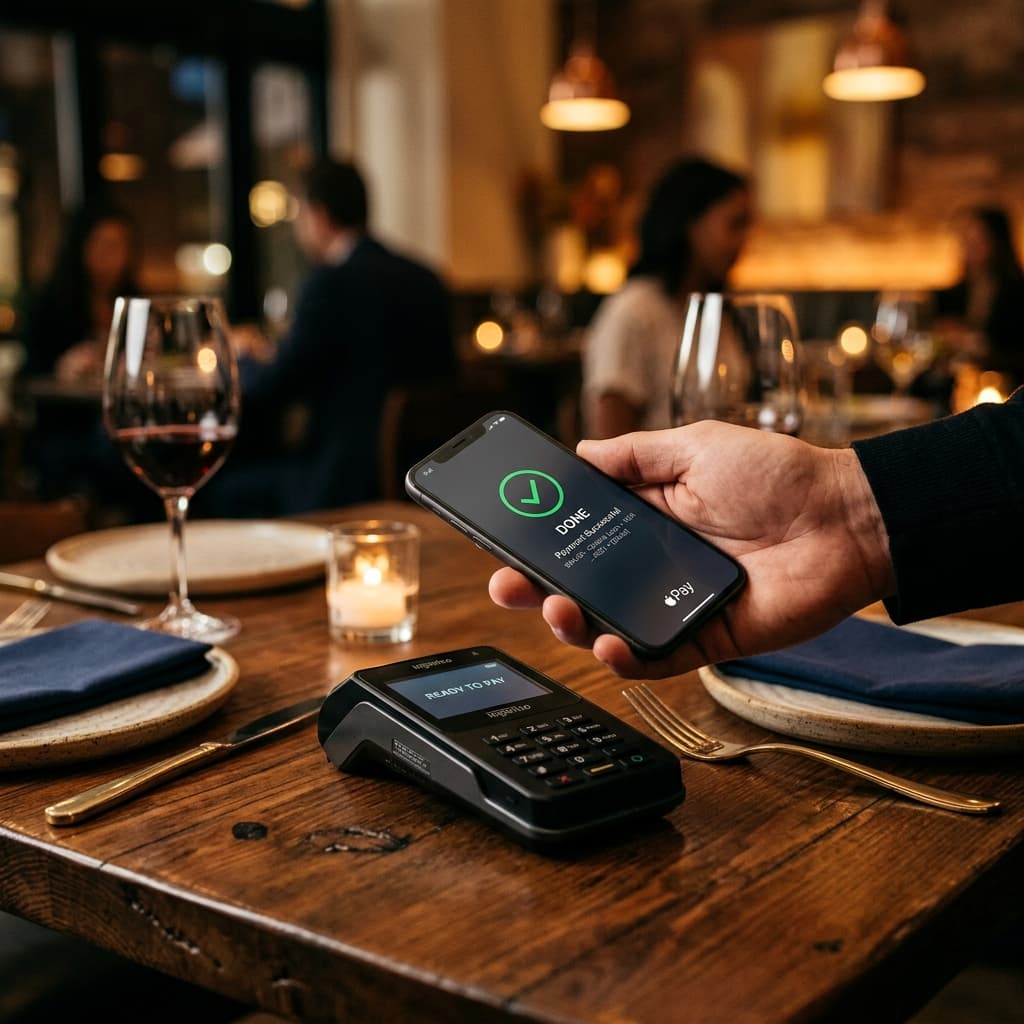
Biometric-authenticated mobile payment — Face ID tap on Apple Pay, fingerprint on Google Pay — has become the fastest checkout method available. A guest paying with Apple Pay at the table completes the transaction in seconds, without fumbling for a wallet, card, or cash. For restaurants, this translates into faster table turnover during busy periods.
The integration with QR ordering systems is particularly powerful. The guest journey — scan QR, browse menu, select items, customise, pay with one biometric tap — is seamlessly end-to-end. No app download. No login. No waiting for the server to bring the card machine.
Modern contactless systems also link automatically to loyalty programs at the moment of payment, eliminating the friction of physical loyalty cards or extra registration steps.
The Balance That Matters
The National Restaurant Association's 2025 report offers the most important strategic insight: 74% of operators believe technology will supplement and augment human labour rather than replace it. The report concludes that restaurants are not looking to replace staff with automation — they are looking to use technology as an enabler of better in-person experiences.
The most successful operators in 2025–2026 apply technology to "frictionless" tasks — paying, ordering, menu browsing — while preserving human interaction for the moments that define hospitality: a genuine recommendation, a well-timed check-in, a graceful resolution of a problem.
This is not a philosophical position. It is a business strategy. Restaurants that automate everything lose the warmth that drives loyalty. Restaurants that automate nothing lose the efficiency that drives margins. The winners operate in the middle — using technology to handle what technology does best, and people to handle what people do best.
The Market Context
The global restaurant technology market is valued at approximately $6.9–8.2 billion in 2026, projected to reach $18–27 billion by the mid-2030s at a CAGR of 14–16%. 82% of restaurant executives plan to increase investment in AI and automation in 2026.
The individual restaurant doesn't need to adopt everything. But understanding where the market is heading — and what guests are beginning to expect — is essential for making informed decisions about which technologies to adopt, when, and how.
The restaurants that will lead the next five years are those that combine the warmth of traditional hospitality with the intelligence of modern technology. The data suggests that guests don't want one or the other. They want both.